VST3 / AU / Standalone / Mac + Windows / Works offline
Virtual synths will never replace analog. Except on a plane.
Your analog rig doesn't fit in the overhead bin. These five do: our models of the Moog Sub 37, Roland Juno-106, Sequential Prophet-5 and Yamaha DX7, and the MXD hybrid poly, each rebuilt from the service manual up. All five are $19.99, and the J106 is free if you want to try one first.
Black Friday price ends in
One payment. No subscription, no licence keys.or try one first
Drag the panel sideways to look around
- 5 instrumentsSub 37, Juno-106, Prophet-5, DX7, MXD
- Mac + WindowsVST3, standalone, AU on Mac
- Works offlineno login, no licence check
- $19.99all five, or the J106 free
The honest pitch
We love the real ones. They just don't fly.
Nothing replaces walnut, voice cards and ten minutes of warm-up drift. But try getting it through security. So we rebuilt five of them as carefully as we could, for every place the originals can't follow: seat 23A, the hotel desk, the back of the van.
In the air
Offline
No login, no licence check, nothing that phones home. Airplane mode is fine.
On the tray table
Standalone
Each synth is also its own app with an on-screen keyboard. A laptop and headphones is the whole rig.
In the bag
6MB each
No sample library to download, because nothing is sampled. Every note is computed as you play it.
01 / The mono
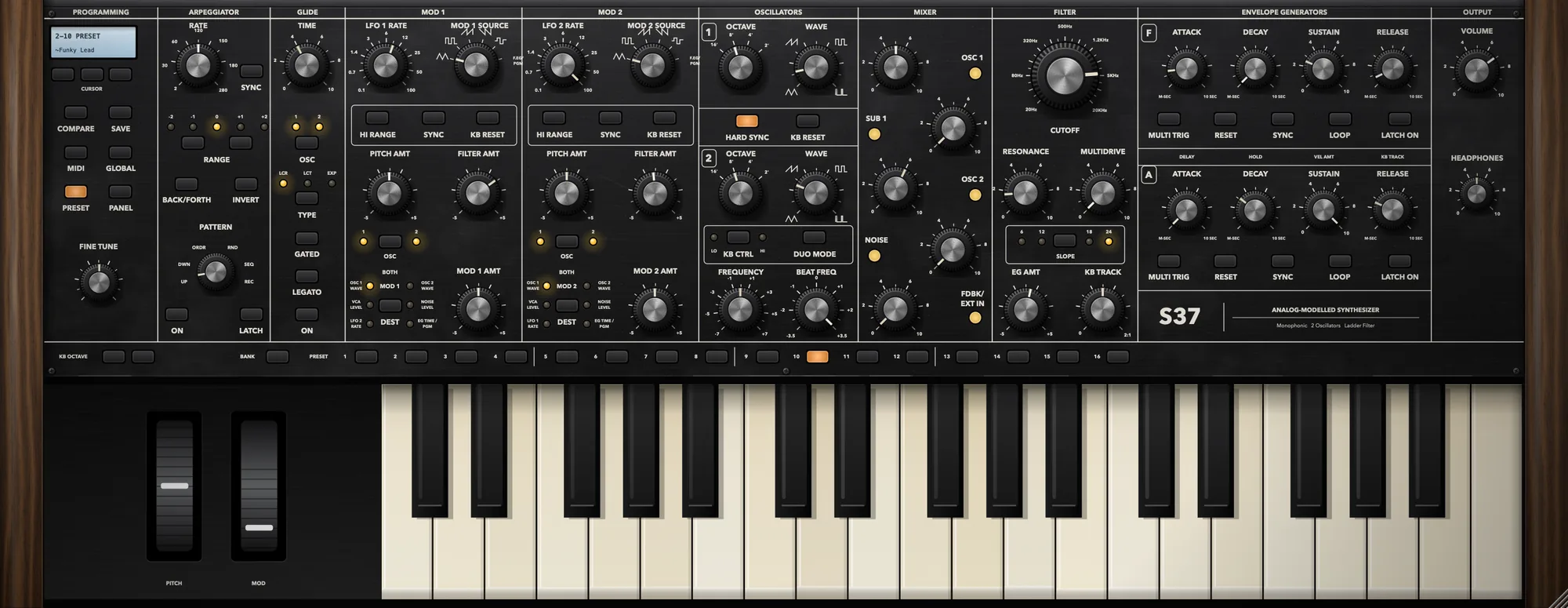
S37 Modelled on the Moog Sub 37
Two oscillators, a sub and a ladder filter that snarls when you lean on the multidrive. Basses that hold a mix up from underneath and leads that go straight through it. Then switch on the sequencer and it plays itself.
- Voice
- 2 oscillators with continuous wave shape, sub, noise and feedback. Hard sync and duo mode.
- Filter
- Zero-delay-feedback ladder with 6, 12, 18 and 24 dB slopes, plus multidrive.
- Mod
- Two mod busses, six sources each. Envelopes that loop, latch and sync to tempo.
- Play
- Tempo-synced arpeggiator and a 64-step sequencer saved with the preset.
- Memory
- 256 preset slots in 16 banks.
- Bass
- Leads
- Sequences
- Sync sweeps
02 / The chorus poly / Free
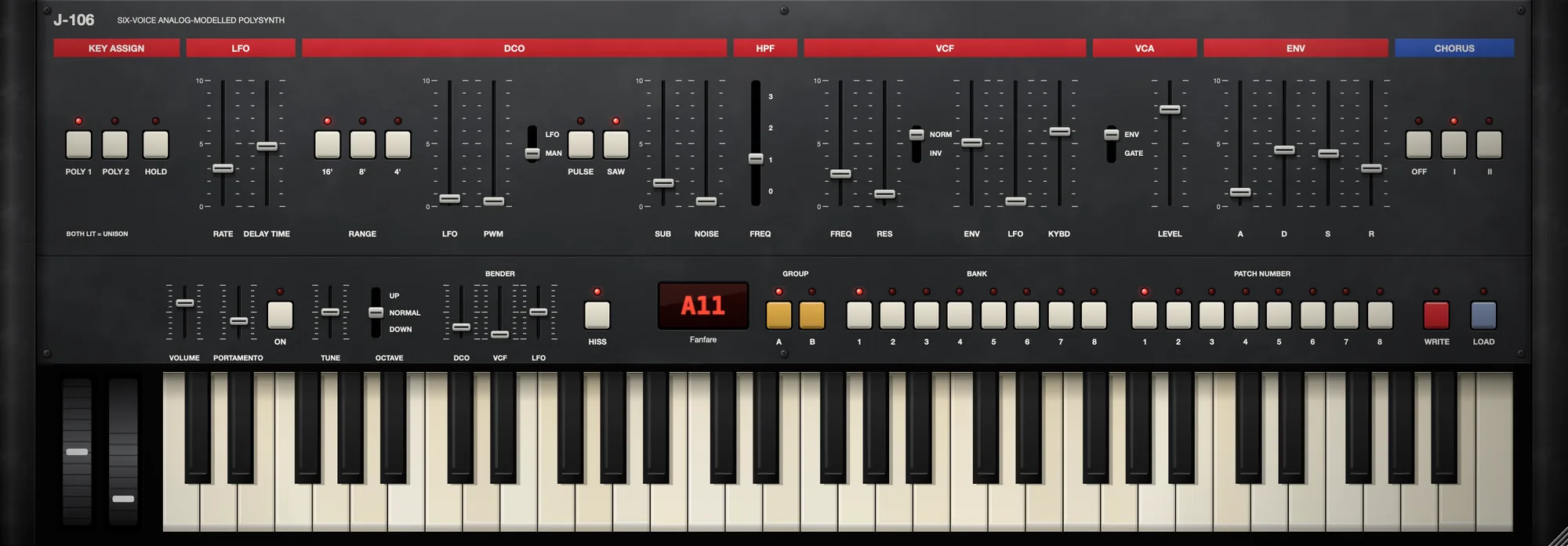
J106 Modelled on the Roland Juno-106
One oscillator per voice and that Juno chorus. Button I is wide, button II is wider. Eleven sliders in, you have a pad, a pluck or a bass that already sounds like a record. There is even a HISS switch.
- Voice
- 6 voices. Pulse with PWM, saw, sub and noise from a digitally controlled oscillator.
- Filter
- Four-pole low-pass per voice, then a four-position high-pass.
- Chorus
- Bucket-brigade stereo chorus, modes I and II.
- Timing
- Envelope and LFO step at the original firmware's 4.23 ms tick.
- Memory
- 128 patches. Imports Juno-106 .syx dumps and listens for SysEx.
- Pads
- Plucks
- Sub bass
- Chords
Get the J106 freefor an email addressMore about the J106
03 / The five-voice
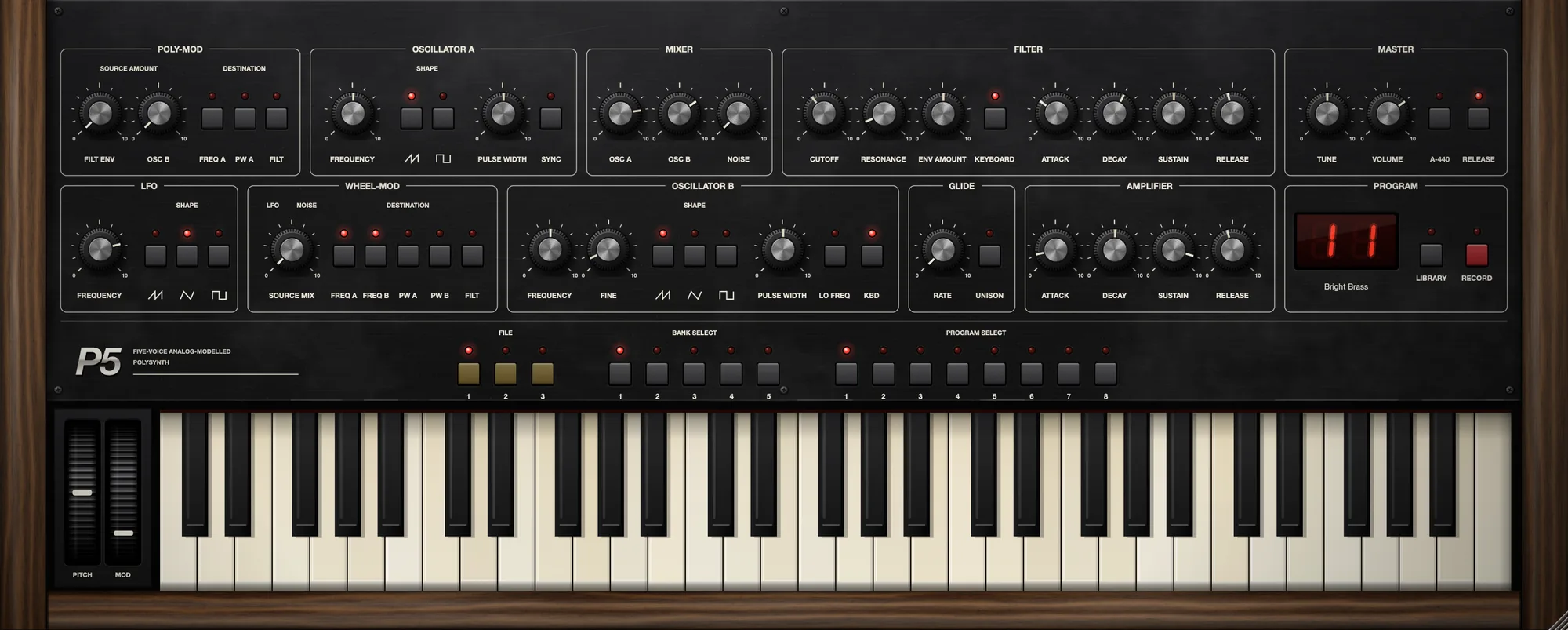
P5 Modelled on the Sequential Prophet-5
The Prophet recipe: two oscillators a voice, and Poly-Mod to bend one with the other. Brass that blooms, sync leads, slow wide pads. Each voice sits a cent or two off its neighbours, the way five voice cards never quite agree.
- Voice
- 5 voices, two oscillators each, with sync, unison and glide.
- Poly-Mod
- Filter envelope and oscillator B routed to pitch, pulse width and filter.
- Filter
- Resonant low-pass with its own envelope and keyboard tracking.
- Library
- Opens over the panel. Search by name or category, rename, store.
- Memory
- 120 programs, with 80 factory programs loaded.
- Brass
- Sync leads
- Pads
- Unison bass
04 / The FM
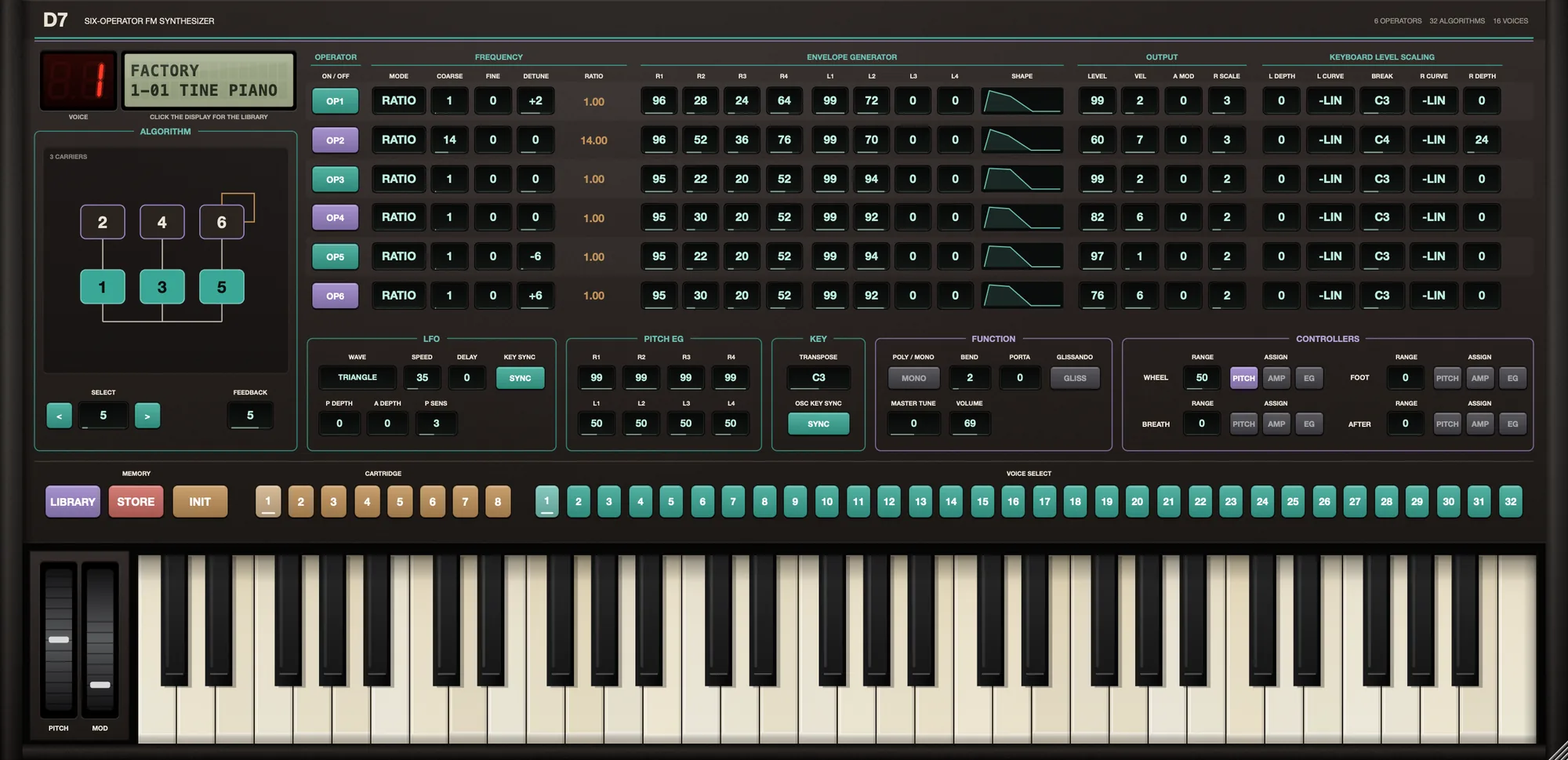
D7 Modelled on the Yamaha DX7
Glass electric pianos, rubber basses, bells: the DX7 sound of a whole decade. The difference is the panel: every parameter on one screen, with the algorithm drawn as a diagram, so you can finally see what FM is doing.
- Voice
- 16 voices of six sine operators, with LFO and pitch envelope.
- Algorithms
- All 32, drawn live as you step through them.
- Engine
- Runs at the hardware's 49,096 Hz, then resamples to your session.
- Patches
- Loads and saves DX7 .syx voices and 32-voice cartridges, from files or over MIDI.
- Memory
- Eight cartridges of 32 voices. Cartridge 1 arrives full.
- Electric piano
- Bells
- Bass
- Mallets
05 / The hybrid
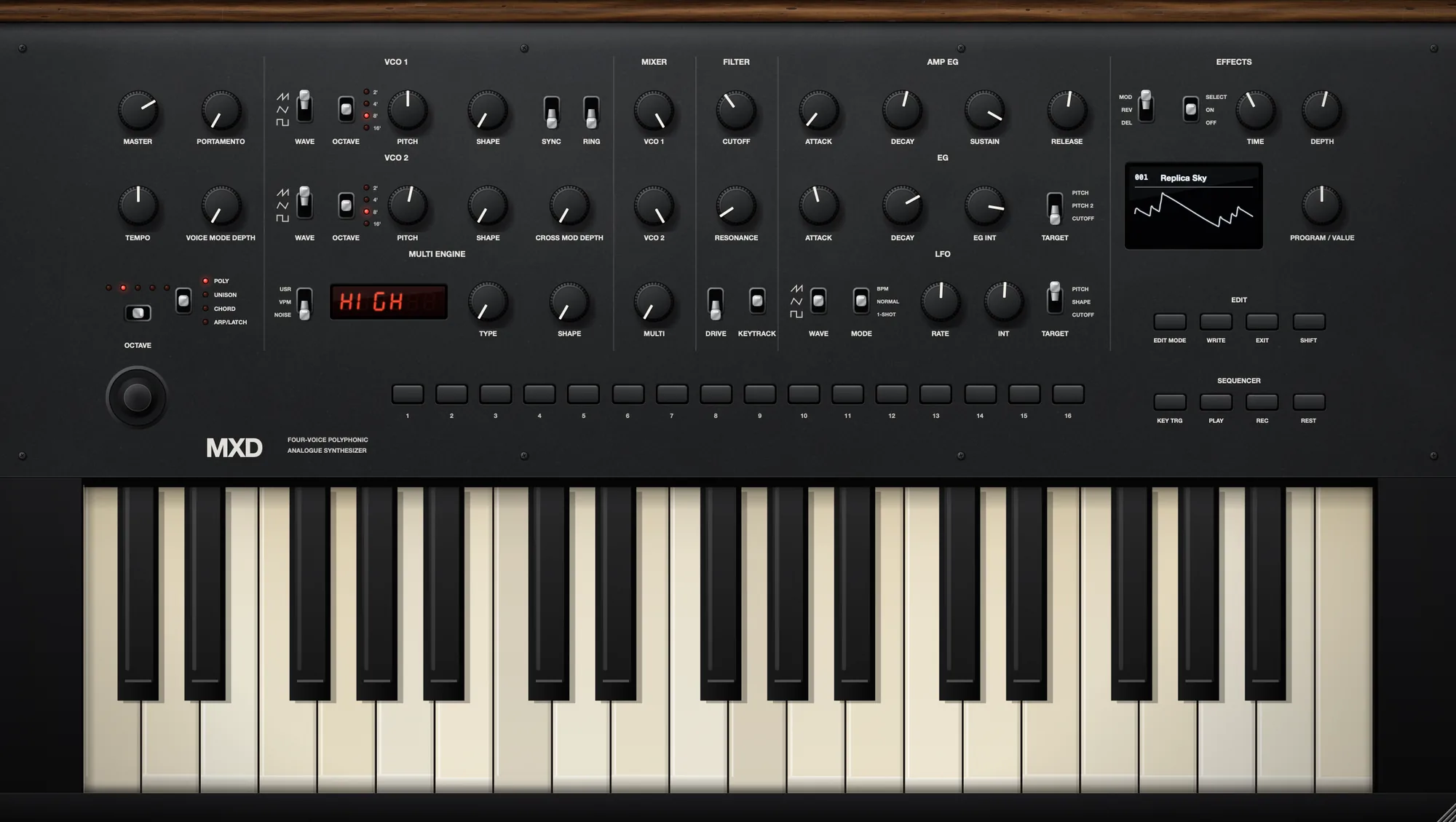
MXD Four voices, analog and digital
Two oscillators a voice, and a digital multi engine beside them for the sounds analog can't reach: noise, VPM and user oscillators. Every program carries its own effects, and the 16-step sequencer records your knob moves as motion, so a pattern keeps changing as it plays.
- Voice
- 4 voices, two oscillators each with wave shape, sync, ring and cross mod.
- Multi
- A digital engine per voice: noise, VPM and user oscillators, each with shape and shift.
- Filter
- Two-pole low-pass with drive and keyboard tracking.
- Effects
- Chorus, ensemble, phaser or flanger, then delay and reverb, stored with the program.
- Play
- Poly, unison, chord and arpeggiator modes. 16-step sequencer with four lanes of motion.
- Memory
- 500 programs, with 136 factory programs loaded.
- Pads
- Sequences
- Arps
- Bass
Why they sound right
Built from the schematics, not from memory.
It still isn't the real thing. It is as close as the service notes, firmware readings and published measurements could get us, and each engine ships with an offline test suite that checks pitch, envelope timing and filter calibration against those figures.
S37
4×oversampled
A zero-delay-feedback ladder and band-limited oscillators, run at four times your sample rate so the drive stays clean of aliasing.
J106
4.23ms
Envelopes and LFO move in the same steps as the original voice CPU, using its tables and integer maths. That stepping is part of the sound.
P5
1–2cents
Every voice has its own small tuning, cutoff and level offset, so chords shimmer the way a five-voice analog does after autotune.
D7
49,096Hz
The FM engine runs at the hardware's native rate and is resampled to your session, so patches land where they did on the original.
MXD
−60dB
The voices run at four times your sample rate, so a sawtooth three octaves above middle C keeps its aliasing 60 dB under the note.
Bring your patches
Forty years of sounds, still loadable.
Three of the five read the originals' own patch files, so the DX7 cartridges and Juno-106 banks you already own, and the thousands floating around the internet, are fair game.
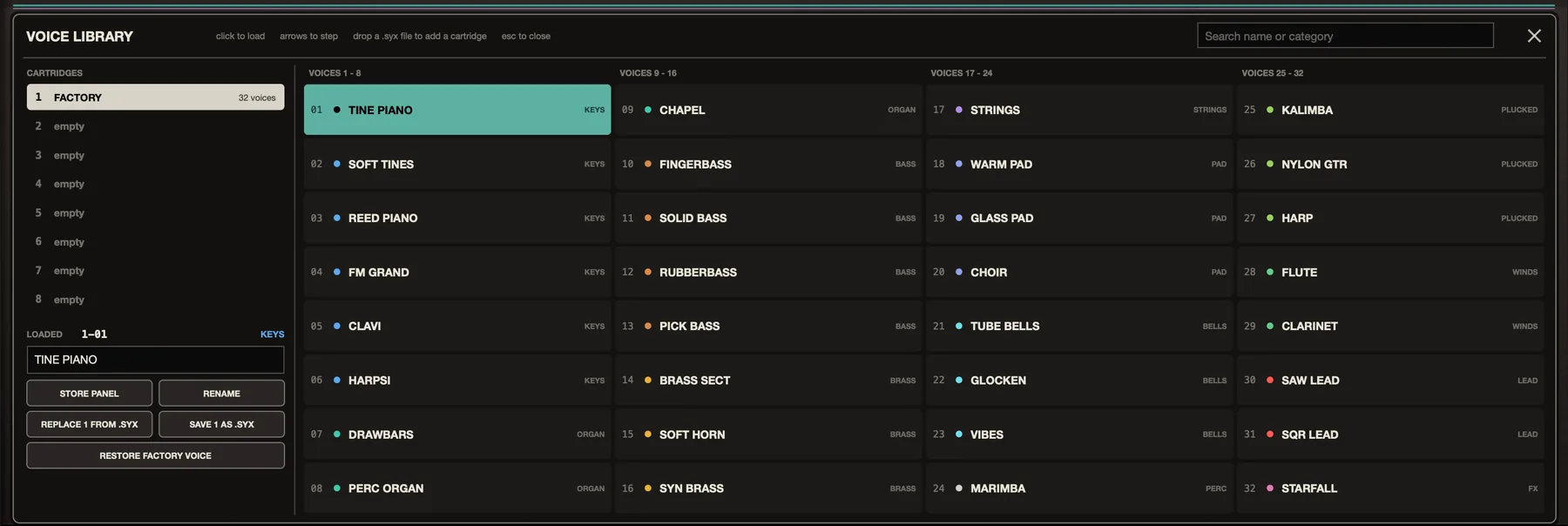
D7Drop a DX7 .syx file on the library and it becomes a cartridge. Save yours back out the same way.J106Imports Juno-106 .syx patch dumps and responds to SysEx and program changes.MXDDrop a program or library file from the original's librarian on the program library to import it. Export yours a program at a time.
Leave the flight case at home. All five, $19.99.
One payment, five instruments: about $4.00 a synth. Or take the J106 for nothing and see how it sits in your tracks.
The set
$99.99$19.99 once
Black Friday price ends in
- S37after the Sub 37
- J106after the Juno-106
- P5after the Prophet-5
- D7after the DX7
- MXDthe hybrid poly
Mac and Windows: VST3, AU on a Mac, and a standalone app for each. Checkout emails you a payment link.
Try one first
J106 free
J106, complete: every slider, all 128 patch slots, no time limit, on Mac and Windows. Yours for an email address.
Questions
What is Virtual Synths?
Five software synthesizers for macOS and Windows: S37, modelled on the Moog Sub 37, J106 on the Roland Juno-106, P5 on the Sequential Prophet-5 and D7 on the Yamaha DX7, and MXD, a four-voice hybrid with a digital multi engine and a step sequencer. Each one is a VST3 plug-in and a standalone app, plus an AU plug-in on a Mac. Nothing is sampled: every note is computed as you play it.
Do they work on macOS and Windows?
Yes. All five synths, the free J106 included, run on both. On a Mac you need macOS 11 or later on Apple silicon, and you get a VST3 plug-in, an Audio Unit and a standalone app. On Windows you need 64-bit Windows 10 or later, and you get a VST3 plug-in and a standalone app; the Audio Unit is Mac only, as Windows hosts don't load that format. One payment covers both systems: the download page has the Mac and Windows installers side by side.
What is free and what is paid?
The J106 is free for an email address, and it is the full instrument: no trial timer, no noise bursts, no saving disabled. All five together are $19.99, paid once.
Is it a subscription?
No. The set is one payment, with no subscription and no licence keys. The J106 is free, with no time limit.
How do I get the synths after paying?
Checkout emails you a payment link for the set, and the download links follow. There are no licence keys to enter.
What do I need to run them?
An Apple silicon Mac on macOS 11 or later, or a 64-bit PC on Windows 10 or later. Each synth comes as a VST3 plug-in and a standalone app, plus an Audio Unit on a Mac, so it works in any DAW that hosts those formats, or on its own with a MIDI keyboard.
Do they work without an internet connection?
Yes. Once installed they never go online: no account, no licence check, no update nag. That is rather the point.
Do they sound exactly like the hardware?
Close, not identical. Each synth is modelled from the service documentation and measured figures, then tested side by side against the real instrument in a professional studio, and they come close enough for what they cost. The demos on this page are straight out of the engines with nothing added (the MXD's play through the effects stored in its programs), so you can judge for yourself.
What will you do with my email?
Send you the J106 download link, then the occasional note when a synth is updated or a new one is ready. Every email has an unsubscribe link.
Do I need the original hardware, or its patches?
No. Every synth has factory sounds built in. If you do have Juno-106 or DX7 .syx patch files, J106 and D7 will load them, and MXD loads the program and library files its hardware original's librarian saves.
Still deciding? The J106 costs nothing but an email address.